
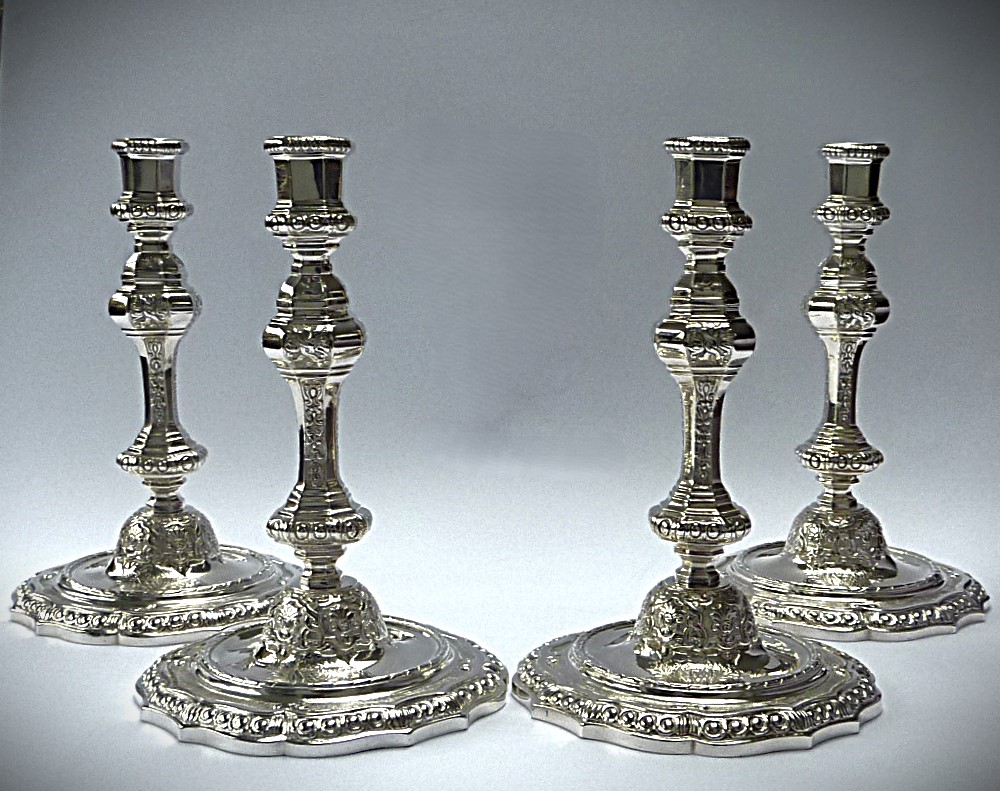
Each on a shaped circular base with bold beaded borders separated by twelve small fluted panels, all enclosing a plain strap with four bifurcated scrolls around a further reserve of matting and below a raised wire of bell flowers. The domed centres elaborately chased with shells, symmetrical scrolls and palmettes on a matted ground, surrounded by a plain surface and engraved with armorials. The baluster columns with an octagonal knop with beaded front at the lower part beneath an octagonal stem with alternate plain and decorated surfaces. The latter chased with trailing symmetrical leaves and scrolls. The upper knops with similar alternate plain and decorative panels chased with intertwined strapwork. The plain octagonal sconces with pendant leaf borders. The bases bearing scratchweights: 23=11, 23=5, 23=17 and 22.16.
Crichton's (probably the most important dealers of their day) Circa 1930
Sotheby's, New York, 20th October 2009, lot 247
Please contact us for further information
These superb candlesticks are made in the French Regence style which is not too surprising as the maker, Charles Hatfield, was apprenticed to two Huguenot silversmiths. The first was Joseph Barbut who is known to have made candlesticks as well as spoons and forks; the second was David Willaume who, significantly, made the famous and magnificent Rockingham ewer and basin in the French Regence style. The armorials have not been traced but we are grateful to Peter Waldron (former head of Sotheby's silver department and long time member of the Antique Plate Committee) who suggested that the arms may have belonged to a non-armigerous wealthy Huguenot merchant.
Hatfield was also one of the Subordinate Goldsmiths to the King from 1723-1739